Muddy Hands, Better Braking: Five Short Winter Sessions Worth Leaving the House For

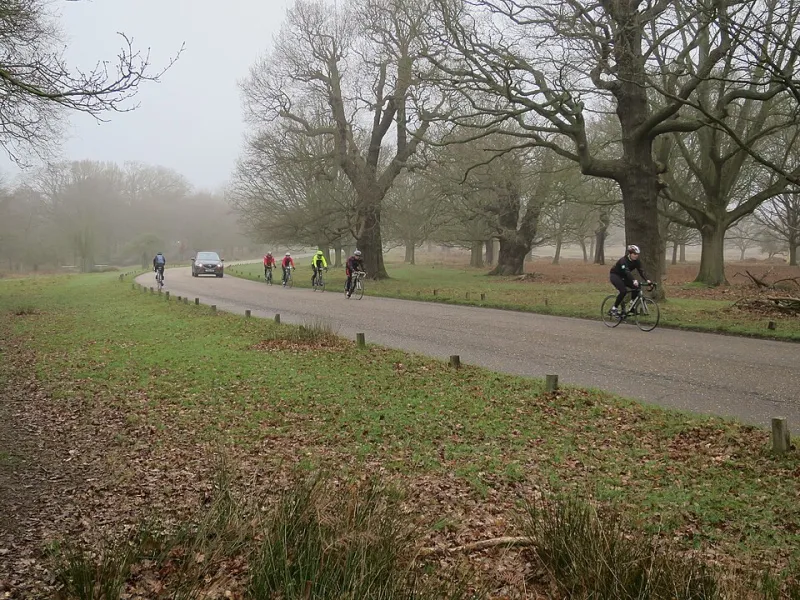
Photo: cyclist riding wet leaf covered country lane winter UK, via www.calpaktravel.com
We sell turbo trainers. We'd quite like to sell you one. But let's be straight about what it does: it builds an engine and slowly takes the driver's licence away.
That sounds dramatic, so here's the ordinary version. Every winter, riders spend three months sweating in garages, then reappear in March with a decent threshold and a genuine fear of wet tarmac. They've held a lot of watts and almost no front wheel. The first fast descent of spring is the one that finds out the difference.
The case against a perfectly controlled environment
Indoor riding removes friction, and friction is where skill lives. No wind chill means you never learn what you actually need to wear. No wet rims or discs means you don't know how long you've got before the bike stops. No leaf mulch, no spread grit, no wet patched tarmac that shimmers like a promise. It's a smooth, warm, controllable environment — which is precisely the opposite of a Kent lane in February.
And it's not just handling. It's the small competence skills: fixing a puncture with numb fingers, judging a bend you can't see round because the light's gone, deciding at 7am whether the road is wet or icy. Those don't come from a power profile.
So here are five sessions that do. All of them fit in a lunch break or a fading afternoon, all of them can be done in ordinary kit, and none of them require a car journey.
Session one: the wet brake test — 20 minutes
Somewhere flat and off-road: a recreation ground, an empty car park, a gravel apron. Not the lanes.
Find a landmark — a cone, a drain cover, a suspiciously proud weed — approach at 12–15mph and stop as hard as you can without locking. Do it five times. Then five more, applying the rear only, and notice how much further you go. Then five with both, feathering the rear to keep it settled.
What you're learning is grip-feedback: how much pressure the tyre gives you before it lets go, and how the surface changes that. Wet tarmac is roughly what it feels like in the dry, minus about a fifth of the braking distance you were expecting. Once you've felt your own braking point on a slippery surface, any indoor sprint session is going to feel a bit beside the point.
Safety: never on the road, never near a junction, and check the surface first — wet grass is not a braking surface, it's a suggestion.
Session two: the layering ladder — 90 minutes
This one is much less glamorous and much more useful than it sounds.
Ride a steady loop out towards Matfield and back with the aim of noticing — not fixing, just noticing — where your body gets it wrong. Are your hands cold by mile ten? Is your core damp? Is the jacket doing the job, or is it a greenhouse with a zip? Then note what you wore and the temperature, and do it again next week with one change.
After three or four rides you'll have a personal system: what you wear at 3°C, at 7°C, at 7°C with rain. That's knowledge no smart trainer can give you, because the trainer has never once been 4°C and windy with the light going.
Safety: short loop, close to home, and never set off on a layering test into an area you can't easily bail out of.
Session three: the cold-hand puncture drill — 30 minutes
Do it once in the garage and you'll be smug. Do it once on a lane in a cold wind with proper gloves and a vest on and you'll be prepared.
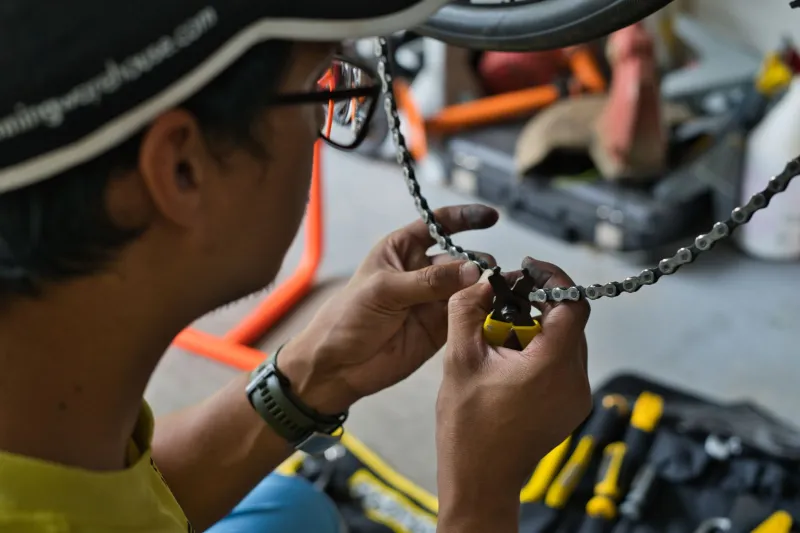
Set a timer. Wheel off, tyre off, tube in, tyre on, reinflate, wheel on. Then do it again without taking your gloves off, and see how much slower you are — and whether you can still feel your thumb.
Finish with a small audit of your saddle bag. If it has one lever, no patch kit and a multi-tool that's mostly Allen keys you don't need, winter is a bad time to discover that.
Safety: pick a quiet lane with a gate or a wide verge, and remember that standing still in the cold is when the body really drops temperature. Have a plan for warming up afterwards — which usually means a café, which is a problem you'll be glad to have.
Session four: leaf-slick cornering — 40 minutes
This is the session people avoid because it feels silly. It isn't silly; it's the one that keeps you off the tarmac in March.
Use a quiet section with a couple of clean bends — the lanes towards Brenchley are ideal — and go through each turn slower than you want, at maybe 70% of your comfort speed. Then build. The specific skills: look through the corner rather than at it, brake before rather than during, keep the weight in the outside pedal, and stay off the front brake mid-turn on anything wet.
On the wet-leaf sections, do not avoid them — ride through them deliberately, in a straight line, and feel how the bike moves underneath you. The goal is to know what a small slide feels like before a big one happens at speed.
Safety: no traffic behind you, dry visibility, and never do this on a blind bend. If a car appears, abandon the exercise.
Session five: the wet descent rehearsal — 45 minutes
Pick a descent you already know — a Pembury-area hill you've ridden fifty times — and ride down it deliberately badly, then deliberately well. Wet, that is, with the brakes on early and gently, straight-line braking only, and the corners taken with a margin.
Then compare. Notice how much further ahead you're looking when you do it properly, and how much less you touch the brakes. The descent hasn't changed. Your reading of it has.
Safety: never a descent you don't know, never in fading light, and never with wet leaves across the whole width of the road. The point is practice, not proof.
The go/no-go test
Braving winter is good. Braving it badly is just an accident with a story attached. Before you leave, run four checks:
- Is there ice? Not 'is it cold' — is there ice. Sheltered lanes keep it until midday and shade keeps it all day. If you're not sure, ride somewhere gritted and open, or don't go.
- Can you be seen, and can you see? Two sets of lights, one blinking or flashing on the rear, and enough charge to get home.
- Is the exposure sensible? A 40-minute loop in a gale is a decent session. A 60-mile one is a decision you'll regret.
- Do you have an out? A route that passes a station, a café or a friend's house is a route you can abandon without it becoming a saga.
If two of those four are doubtful, the trainer gets the win, and you should take it without guilt. The point isn't to suffer in the cold for its own sake. It's to stay good at the thing you're training for — which is riding a bike, on real roads, in real weather, in a form that doesn't fall off.
Where the turbo still earns its place
Interval sessions after dark, recovery spins, race-specific efforts, and the days when the roads are genuinely dangerous. It's a superb tool. Just don't let it be the only tool in the box between October and March — because when spring arrives, fitness is the thing you can buy back in six weeks. Handling isn't.