Errand Miles Count: Why the Trip to Tonbridge Beats Another Heroic Sunday
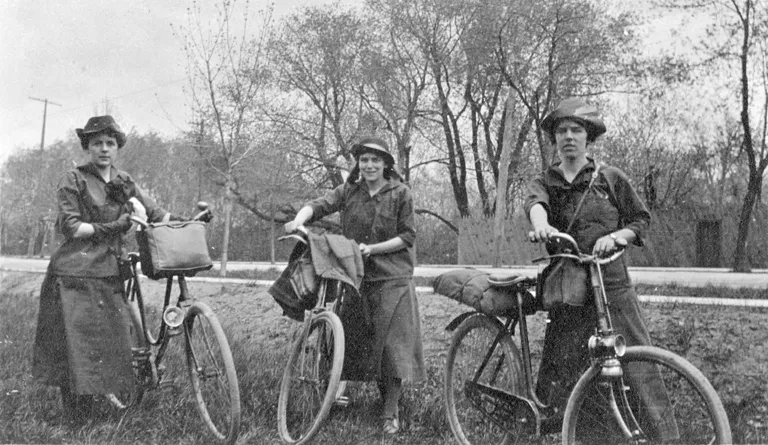
Photo: Musée McCord Museum, No restrictions, via Wikimedia Commons
There's a particular look you get in a bike shop when someone says they're after a bike "just for popping to the shops". It's a polite nod, a slight downward glance, and the quiet assumption that what they really mean is a bike they'll hardly use. We'd like to push back on that. The short utility ride — the school run, the pharmacy trip, the Wednesday evening dash for milk and something for tea — is not the poor relation of proper cycling. It's the backbone of it.
The ride you don't kit up for
A Sunday century requires planning. You check the weather, charge the computer, fill three bottles, debate arm warmers for eleven minutes and then spend the first ten miles remembering how your legs work. An errand ride requires shoes. That's about it.
And that low barrier to entry is exactly why it's so useful. You do more of it. You do it in ordinary clothes, in ordinary weather, on roads you know like the back of your glove. You learn how your bike behaves when you're not mentally prepared for a "session". You learn to read traffic when you're distracted by a mental shopping list. You learn that a loaded pannier changes the steering, that wet leaves on the descent into town demand respect, and that a rear light is not optional just because the sun is technically up.
Those lessons stick because they're real. There's no interval timer, no Strava segment, no one to impress. Just you, a bike, and a reason to be somewhere.
Why three miles beats thirty (sometimes)
We're not saying long rides are pointless. They're brilliant. But there's a quiet snobbery in cycling that treats distance as the only currency, and it misses something important: frequency beats heroics for most people most of the time.
Three miles into Pembury and back, four times a week, is twenty-four miles you wouldn't otherwise have ridden. Do that for a month and you've banked nearly a hundred miles without once blocking out a Sunday. Your legs notice. Your lungs notice. More importantly, your handling notices. Short, repeated trips teach you how to start and stop smoothly, how to look over your shoulder without drifting, how to carry a loaded bike through a narrow gap, and how to brake on a greasy surface without grabbing a handful of front brake and scaring yourself silly.
That's not training in the structured sense. It's something better — it's practice.
Local proof: Pembury to Tonbridge, via the lanes
Take a ride we do often: Pembury into Tonbridge for a few bits and a coffee. It's about four miles each way if you take a sensible route, and it's got everything. A bit of traffic near the A21, a couple of proper climbs if you want them, a fast descent if you're feeling brave, and enough surface changes to keep you honest.
Do that ride twice a week for a month and you'll know exactly where the drain covers sit after rain, which lane floods near the ford, and which driver in the village always pulls out without looking. That local knowledge is worth more than any skills course. It's the kind of thing you can only learn by turning up in ordinary conditions, on an ordinary bike, with an ordinary reason to be out.
The same goes for the school run in Pembury, the trip to the library in Tunbridge Wells, or a quick loop to the shops in Southborough. None of them are glamorous. All of them are cycling.
The errand bike deserves better
Here's where we get opinionated. The bike you use for short trips is the one you rely on most, and yet it's usually the one with the cheapest tyres, the dimmest lights and the squeakiest brakes. That's backwards.
In 2026 there's no excuse for a dodgy rear light. A decent USB-rechargeable set costs less than a takeaway and means you're visible on a grey November afternoon when the light goes flat at half four. Likewise tyres: a pair of puncture-resistant, reasonably quick tyres transforms a heavy old hack into something you actually want to ride. Add mudguards if you haven't already — not for style, but because arriving at the school gate with a wet stripe up your back gets old fast.
And give the thing a lock you trust. A cheap cable lock is a "please take me" sign. A decent D-lock or a sturdy chain means you can leave the bike outside the shop without spending the whole time inside worrying about it.
What to carry (and what to leave at home)
You don't need much for a three-mile errand, but a few things earn their place permanently in a saddlebag or pannier:
- A spare inner tube, tyre levers and a mini pump that actually works on your valves.
- A multi-tool with the right sizes for your bike — check before you need it.
- A lightweight waterproof shell that lives in the bag, not the wardrobe.
- A bungee cord or two, because "just a couple of things" has a habit of becoming four bags of shopping.
- A small lock, if your main lock is too heavy to lug around.
Leave the race nutrition, the heart-rate strap and the fourth layer at home. This isn't that kind of ride.
Dressing for ordinary weather, not a sportive
The biggest reason people don't ride short trips is that they think they need to get dressed for it. You don't. A normal jacket, normal trousers and normal shoes will get you three miles into town and back perfectly well, especially if you keep the pace sensible.
The trick is layers and a bit of pragmatism. A waterproof jacket that packs small, a pair of gloves in the pocket from October onwards, and a cap or buff for the drizzle. If you're going somewhere smart, ride slower and leave the lycra at home. Nobody at the pharmacy counter cares what you're wearing. They care that you're not taking up the last parking space.
Make it a habit
The three-mile rule isn't really about distance. It's about permission. Permission to count the small rides. Permission to use a bike for the boring stuff. Permission to treat the errand bike as a proper bike, with proper kit, looked after properly.
So next time you reach for the car keys for a trip you could easily ride, try the bike instead. Pop the lock in a bag, check the lights, and go. You'll be back before you'd have found a parking space, and you'll have banked a few more miles of the most honest cycling there is.