Listen Before You Loosen: Three Bike Noises Worth Chasing Early
Photo: bicycle mechanic listening to bike brake caliper in workshop close up, via cdn.pixabay.com
There's a look we get across the workshop bench most weeks: a rider who has spent forty minutes hunting a squeak, given up, and rolled in with a face like thunder. Nine times out of ten we find it in about ninety seconds — not because we're wizards, but because we listen in a slightly more organised way.
Bikes talk constantly. Most of it is harmless chatter: a mudguard vibrating, a dry chain, a valve collar tapping the rim on a fast descent. But three noises come up again and again with Pembury riders, and all three are worth chasing while they're still cheap. Here's how we'd go about it at home, with nothing more exotic than a multitool and a quiet stretch of tarmac.
Count the rhythm before you touch a bolt
The single most useful thing you can do is work out how often the noise happens. Get the bike on a stand, or on a lane where you can hear yourself think — Common Road on a Sunday morning will do — and listen properly.
- Once per wheel revolution? That's rotational: spokes, rim, valve, tyre, mudguard, sensor.
- Once per pedal revolution? That's drivetrain or contact point: cleat, pedal, chainring bolt, quick link, saddle rails.
- Random, or only under load? That's usually a clamped joint shifting: seatpost, stem, bottom bracket, crank.
Half of all diagnosis is that one question. Answer it honestly and the rest tends to fall out.
The squeak: brakes, nearly always
A rhythmic squeak that follows wheel speed is brake noise nine times out of ten. On Kent lanes in winter it's usually contamination — a fine paste of flint grit, road spray and whatever the gritter left behind, worked into the pad surface. Glazed pads make the same noise: the surface goes shiny and hard and squeals instead of gripping.
Lift the front wheel, spin it, and put your ear by the caliper. Then look at the pads. If the friction material is a quarter of the way down to the backing plate, you've got life left. If you can see metal, stop.
Red flags worth stopping the ride for:
- A grinding rather than squeaking noise.
- Pad material at or near the backing plate.
- Deep scoring or a blue tint on the rotor face.
- A lever that pulls noticeably further than it did on the last ride.
Roadside fix: a clean rag and a splash of water will get you home from a squeaky-but-working brake. Do not spray anything oily anywhere near a disc. Back at base, clean the rotor with isopropyl alcohol and fit fresh pads if the old ones are glazed or thin — a set of pads costs a fraction of a rotor, and a rotor costs a fraction of the crash you'd rather not have.
Harmless cousin: the squeak that appears only when you're walking through a café in cleats. That's the cleat, not the bike, and it's nobody's problem but the floor's.
The creak: a clamped joint has lost its manners
Creaks are the noises riders blame on the bottom bracket, and they're almost always wrong. The BB is the most expensive thing down there, so naturally it takes the blame.
Try this order, cheapest first.
Seatpost and saddle rails. Stand out of the saddle and pedal hard on a smooth lane. If the creak vanishes, it's the saddle or seatpost. Pull the post, wipe it, re-grease it (assembly compound on carbon). Check the rail clamps and the saddle bolts.
Pedals. An under-greased pedal thread is a beautiful creaker. Take them off, grease the threads, refit firmly.
Chainring bolts. Dry chainring bolts creak in time with your power strokes and sound exactly like a dying bottom bracket. A drop of grease on each and a proper tighten costs nothing.
Crank bolts and the BB itself. Only after everything above. If there's lateral play in the crank — rock it side to side with the chain off — that's a bearing on its way out and it needs doing now, not in March.
Red flags here are serious, because the parts involved hold you up. Any creak accompanied by movement is a stop-and-inspect. A sharp pop rather than a creak, especially near the bottom bracket or head tube on a carbon frame, means a proper look before the next ride. And a loose square-taper crank will quietly ream itself into scrap while you enjoy the scenery.
The click: timing tells you everything
Clicks are the most satisfying noises to fix because they're so specific.
- Once per wheel revolution: spoke nipple, valve collar, wheel magnet or sensor, a stone lodged in the tread, a mudguard stay touching the tyre.
- Once per pedal revolution: cleat rocking in the pedal, a chainring bolt, a dry pedal bearing.
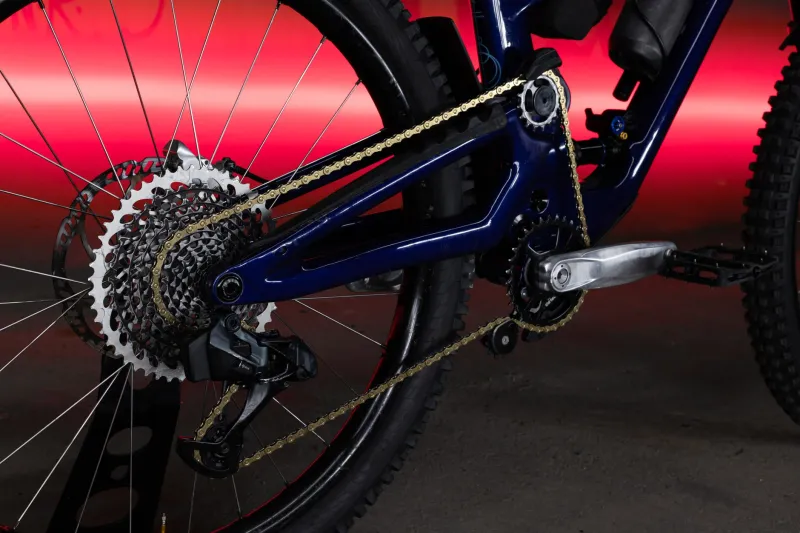
- Once per chain lap: a stiff link. Backpedal slowly and watch the rear derailleur cage — a stiff link makes it jump.
- Only under hard efforts, in certain gears: hanger alignment, worn cassette teeth, a chain past its wear limit.
That last one is the one to take seriously. A click that comes with a missed or ghosted shift is usually a bent hanger, and it's a two-minute fix with the right tool rather than a new cassette. A stiff link left alone will eventually snap a chain, usually on a hill, usually in the rain.
What you can genuinely ignore
We're not going to pretend every noise is a crisis, because then nobody listens to us at all.
- Mudguard and rack rattle: annoying, harmless, fixed with a bit of tape.
- Valve collar ticking against the rim: harmless.
- Chain chatter on a dry chain: the chain telling you it's dry.
- Jockey wheel whirr: fine until it becomes a grind.
- Cleat squeak off the bike: fine.
A five-minute protocol that saves actual money
- Clean and lube the chain first. A surprising number of diagnostics end right here.
- Count the rhythm on a quiet lane.
- Check seatpost, pedals and chainring bolts with the correct torque — a torque wrench is the cheapest insurance in cycling.
- Pull the brake pads and look at them properly, wheel out if needed.
- If there's play anywhere, or the noise is metallic, stop and book it in.
A noise is the bike giving you notice. Chasing a squeak costs twenty minutes and a set of pads. Ignoring a creak can cost a bottom bracket, a crank, or in the worst case a frame. Bring it past the shop and we'll listen to it with you — there's no charge for the diagnosis, and we'd genuinely rather you did.