The Ten-Minute Wedge Audit: Packing for Wet Kent Lanes Without the Kitchen Sink
There is a particular kind of archaeology that happens on a wet November morning in Pembury. You are at the side of a lane, rain running off your helmet, and you open the saddle bag to find a tube for a tyre width you no longer use, a gel that expired during the last administration and a CO2 cartridge that feels suspiciously light. The bag itself is not the problem. The problem is that it has been packed by hope rather than by plan.
A ten-minute audit before winter is one of the cheapest upgrades you can make to your riding. It is not about buying more kit. It is about deciding what earns its place in the wedge, what can stay at home and what needs replacing before the next muddy loop out towards Matfield or down the lanes behind Brenchley.
Empty it onto a tea towel
Start indoors, with decent light. Tip everything out, wipe the inside of the bag and check the zip and straps. Saddle bags fail slowly: a worn strap, a zip that opens from the bottom, a hole where the tool has rubbed. You do not want to discover that on a dark lane with cold hands.
Be ruthless. If you cannot remember using an item in the last year, it either goes in the long-ride box or stays at home. The goal is a bag you can open in the rain without playing lucky dip.
Tubes: match the tyre, not the drawer
This is where most bags go wrong. A tube that is too small for the tyre has to stretch a long way, and it can fail when you need it most. A tube that is too big is awkward to fit and can pinch under the tyre bead. For most UK riders on 25mm to 32mm road and winter tyres, a 700x25-32 tube is the sensible default. If you run 32mm gravel tyres, check the box and carry a tube that genuinely covers that width.
Valve length matters too. A short valve on a deep rim is a roadside argument with a pump. One tube is enough for most local rides. Two is reasonable for a long winter epic or a remote gravel day where you cannot call for a lift. Keep the tube in a small zip bag with a little talc if you have it, and make sure the valve core is tight.
Patch kit or spare tube?
The honest answer is that a spare tube is faster, cleaner and easier when your hands are cold. Patches are brilliant for the second puncture, for a tube you have already swapped, or for a longer ride where you want a backup. In a wet lane, though, glue-based patches need a dry, clean surface and a bit of patience. Self-adhesive patches are handy but not magic.
For most Pembury riders, carry one spare tube and a small patch kit. Use the tube first, then patch the punctured one at home. If your rides are short commutes, a tube and a couple of self-adhesive patches will do.
CO2 or mini-pump?
CO2 gets you going quickly, but it is a one-shot tool. If you misfit the head, freeze your fingers or waste the cartridge, you are walking. A mini-pump is slower and less glamorous, but it always works. For Kent lanes in winter, a pump with a flexible hose and a decent valve head is the better primary tool. CO2 is fine as a backup or for riders who know exactly how to use it, but do not carry a cartridge instead of a pump unless you have practised with it.
Test your pump at home. A pump that only works when the valve is at a certain angle is not a pump; it is a trail-side disappointment.
Levers, quick link and multitool
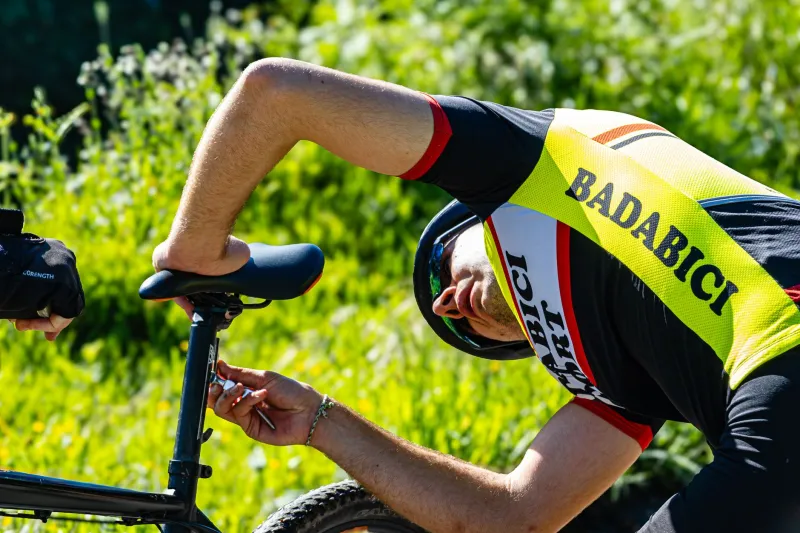
Two decent tyre levers beat one. A quick link matched to your chain speed is small, light and can rescue a broken chain. Make sure it is the right speed, and know how to fit it. A multitool should cover the hex keys your bike actually uses, plus a Torx bit if you have disc brakes or a modern stem. Leave the workshop tool at home. You are not rebuilding a bottom bracket on a bridleway.
The small stuff that earns its place
A few zip ties can hold a mudguard, cable or bottle cage out of trouble. A folded fiver is a tyre boot, a café emergency fund and a useful wedge. A pair of nitrile gloves keeps the worst of the wet lane off your hands and gives you grip when everything is slick. A small cloth is worth its weight for glasses, a chain or a muddy light lens.
The one thing everyone forgets
A tyre boot. Most riders carry a tube, levers and a pump, but a sidewall cut can end the ride even when you have a spare tube. The tube bulges through the cut and fails. A proper tyre boot, or a folded note in a real emergency, sits inside the tyre and gets you home. Kent lanes are full of flint, grit and potholes that have been quietly sharpening themselves all summer. Add a boot to the bag and learn how to fit it before you need it.
The ten-minute shakeout checklist
- Empty, clean and inspect the bag and straps.
- One tube that matches your actual tyre width, with the right valve length.
- Patch kit or self-adhesive patches for the second puncture.
- A tyre boot, or a folded fiver as a backup.
- Mini-pump tested at home.
- Two tyre levers.
- Quick link for your chain speed, plus a chain tool if your multitool has one.
- Multitool with the hex and Torx keys your bike needs.
- Zip ties, nitrile gloves and a small cloth.
- Phone, card and some ID.
Pack it so you can find it
Put the heavy items low and central. Keep the tube and levers where you can reach them without unpacking the whole bag. Do not cram the wedge so full that the zip strains or the bag rubs the seatpost. A saddle bag does not need to be a survival kit. It needs to be a small, reliable answer to the most common roadside problems.
Ten minutes now is better than twenty minutes in the rain later. Pack for the lanes you actually ride, not the ones you imagine. And if you only add one thing this winter, make it the tyre boot. It is the cheap, boring item that turns a ride-ending cut into a slow, cautious pedal home.