Shallow Isn't Safe: Judging Water on Kent's Winter Lanes

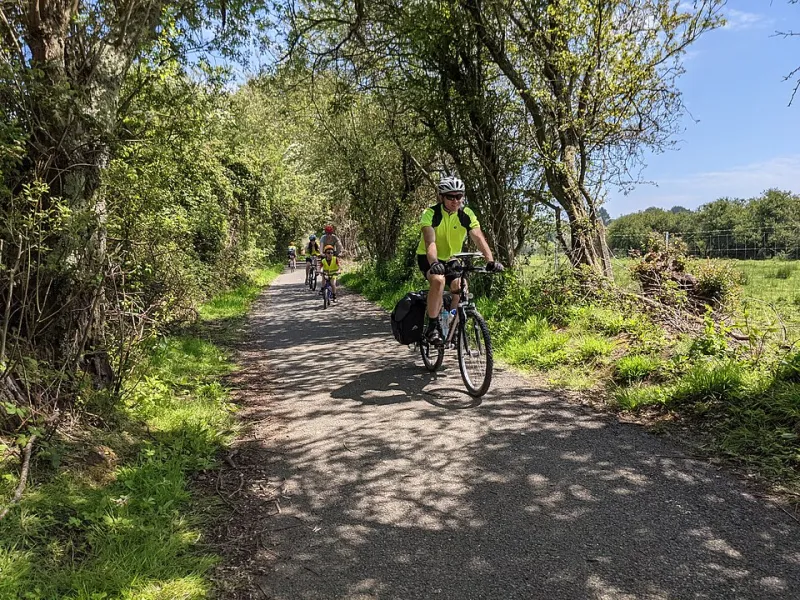
Photo: Joe Mabel, CC BY-SA 4.0, via Wikimedia Commons
It is the middle of November, the ground is full, and the Weald has started holding water again. Every year about now, a route that looked perfectly sensible on the map turns into a string of brown puddles with no visible bottom. Some are two centimetres deep. Some are old potholes wearing a disguise. One or two are genuinely a ford.
You do not need to be brave about any of this. You need to be nosy.
Start with depth, and be honest about the number
Forget the look of the thing and use the bike as a ruler. On a typical 700c wheel, the hub sits roughly 33 to 35cm off the ground. Your bottom bracket is lower still, somewhere around 27cm on most road and gravel frames. Those two numbers give you a decent working limit.
If the water is only reaching the bottom of your tyre, you are fine. If it is lapping at the hub, you are at the edge of anything pleasant, and your wheel bearings are getting a bath they did not ask for. If it is over the bottom bracket, or over the crank axle, stop pretending this is a cycling decision. It is a wading decision.
There are other clues. A dark, wet tide mark running along the hedge tells you how high the water has recently been. Strands of grass and twigs caught on a fence post tell you the same. A line of silt across the tarmac shows where a sheet of water has been running and where it has dropped its load. Read those before you read the puddle.
Colour and movement are telling you things
A clear, still sheet over tarmac is often shallower than it looks — the road surface is just doing a good impression of a swimming pool. Brown and still is usually just silt, though it can hide a great deal.
Moving water is a different conversation. If it is flowing across the lane, the road underneath may be scoured, and the edges may be undercut. Water arriving from a field gate or a ditch is water with momentum, and momentum is what takes a front wheel out from under you. Ripples that are not caused by the wind are a warning, not a welcome. And if the surface is breaking in small waves as a car approaches, get out of the way before the bow wave arrives — a wave over your drivetrain is worse than the puddle that caused it.
Pick a line, not the middle
On a proper two-lane road, the crown is usually the highest point, so drifting towards the middle can keep your hubs dry. On a narrow Wealden single-track lane, though, the middle often holds the deepest water and both edges are soft. That is when you want the high side — usually the side where the hedge sits slightly above the road — but only if you can be sure there is still road under it.
Where a field drain empties out, expect a channel. Where a gateway opens onto the lane, expect a fan of washed gravel. Where the road bends, expect the water to have pushed everything loose towards the outside of the curve. The low side of a lane is the low side for a reason, and it is usually where the ditch is pretending to be tarmac.
Assume there is something under it
Cold, brown water is the best camouflage in Kent. Underneath that innocent sheet you may find a pothole, a sunken drain cover, a loose kerbstone, a brick, a root, or a patch of flint gravel that has washed off the field and settled in the dip. None of those are visible, and none of them are your friend at 20mph.
This is why the old trick of prodding ahead with a foot or a stick is not as daft as it looks. If you cannot see the bottom, do not assume the bottom is flat.
Walking is a legitimate technique, and there is a right way
Get off before the water, not in the middle of it. Unclip early, keep your feet dry if you can, and walk the verge if the verge is not itself a ditch. If you are carrying the bike, lift it properly — frame in one hand, front wheel raised, or shoulder it if it is light enough — rather than dragging it through by the bars and letting the rear mech plough the bottom.
In a group, send one rider through first and have them signal back the depth and the line. Do not all pile in behind a rider who has just discovered it is knee-deep.
The turn-around rule
There is no prize for crossing. Turn around, or reroute, if any of the following apply: the water is moving faster than a walk, it is above your ankle and you cannot see the bottom, it is over the hub, the edges are icy, it is getting dark, you are on your own, or the only line through puts you in the path of traffic you cannot see coming. A five-mile detour on dry tarmac beats an hour of roadside repairs in the cold.
Local lanes that deserve a rethink after a soaking
The flat clay between Five Oak Green and Capel holds water for days. The low bottoms around Matfield and Brenchley are notorious after a night of rain, and the lanes skirting the ponds near Chiddingstone can surprise you well into the following afternoon. Anything draining off the high ground towards the Medway — the Ashurst and Fordcombe back lanes in particular — will be running hard while the roads nearer town are already drying. None of these are closed, and none of them are forbidden. They are simply worth avoiding on the morning after, when the ditches are still full and the grip is still rubbish.
The ten-minute clean-up when you get home
Brakes first. Grit on a rim or a disc rotor turns a good brake into a grinding one, and contaminated pads rarely come back. Rinse the whole bike with low-pressure water — a hose, not a jet, and never aimed at bearings — then dry it and lube the chain properly.
Spin the wheels and listen. A gritty hub or a rough bottom bracket after a soaking is much cheaper to catch now than in February. Check the headset by rocking the bike with the front brake on. Wipe the rotors with a dedicated cleaner, not a rag that has been on the chain. Dry your shoes somewhere warm but not on a radiator, and empty the saddlebag before the damp gets into everything.
Kit that earns its place
Mudguards keep the worst of it off your back and your drivetrain. Sealed bearings pay for themselves the first time you ride through standing water. A small brush and a bottle of chain lube live by the back door for a reason. A spare pair of socks in a dry bag is the cheapest comfort upgrade in cycling.
The puddle is not the enemy. Guessing is.